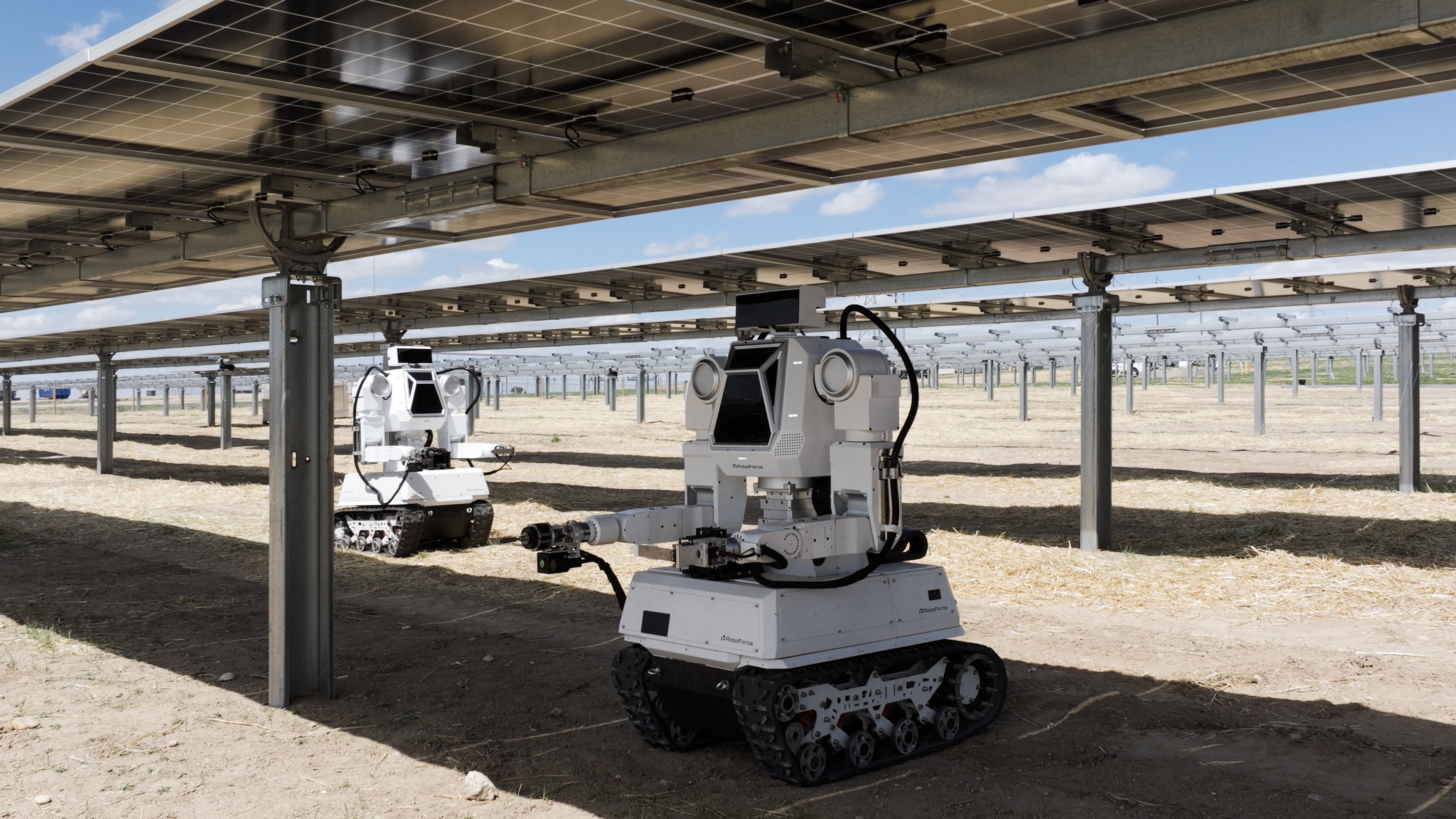
Some of the world’s most essential work is also the most demanding.
The energy that powers our cities, the infrastructure behind AI, and the products we depend on every day all require people to perform physically demanding, repetitive, and often hazardous work.
Demand is growing, while skilled labor remains in short supply.
Consider utility-scale solar. A 1 GWdc project using 600 W modules requires approximately 1.7 million panels, each secured to the structure. Each connection demands precision and repetition across the site.
For people, it means repeated tool use, awkward working positions, and long hours in demanding conditions. Recruiting experienced crews is already difficult: In 2024, 86% of solar employers reported difficulty hiring (IREC Solar Jobs Census).
But the work isn’t just hard on people. It’s also hard for existing machines to do reliably.
For a robot, the hard part is intelligence, not motion. Construction sites are open and constantly changing. Terrain, lighting, weather, and structural conditions vary across locations and over time. Robots must adapt to these differences while executing tasks with millimeter-level precision. That requires more than predefined motions. It requires the ability to perceive, understand, and respond to unfamiliar conditions.
The hardest work is hard twice: hard on people, and still hard for machines. We believe robot intelligence should start here, where the need is greatest and human willingness is lowest. Starting here pushes our system to become more capable, and what we learn from these challenges becomes the foundation for taking on more industrial work.
Difficulty alone is not a reason to build a robot. The work has to matter. Three choices have guided us.
We build tools, not toys. This was the first choice we made when starting our company. A demo can attract attention. A useful tool has to understand the work, finish the tasks, meet the standards, and fit into a crew’s day.
We choose work where the value at stake is large. The value of automation goes beyond individual tasks. It addresses labor shortages, improves worker safety, and helps customers scale their operations. We go where the value is, not where the work is easy.
We want customers to build more with the people they have. Taking demanding, repetitive tasks off experienced workers lets a crew complete more and direct its skills where they matter most. We measure success by the additional capacity created, not simply the labor costs we reduce.
Together, these principles guide us toward high-value industrial applications where reliable automation can make a meaningful difference. By solving real industrial challenges, we aim to increase productivity, expand capacity, and deliver measurable value to customers. That starts with building the intelligence and hardware capable of doing the work.
A useful AI robot needs a capable model, relevant data, and hardware strong enough to execute. Each is necessary. A model cannot lift beyond the robot’s capacity, a strong arm cannot decide how to recover, and more data helps only if it captures what the task requires.
RF-0 is our end-to-end robot foundation model, developed in-house for more than two years.
Before it, we started in 2023 with our first robot autonomy stack: modular, AI-driven perception, planning, and control that put TITAN to work in the field. That stack also exposed its limits: calibration sensitivity, difficult corner cases, and tuning every new setup.
To move past those limits, we built RF-0. Robot images, robot state, and a language instruction go in; robot actions come out. Learning perception, task understanding, and control together lets us address variation through experience instead of an engineering fix for every new condition.
That experience comes from real robot data, handheld device data, and simulation data. Together they cover the robot doing the work, demonstrations of the work, and conditions we can construct and vary. The goal is reusable skills grounded in industrial tasks.
TITAN, our general-purpose AI robot, brings the hardware to the same standard. Built for deployment and scale, it has dual arms, tracked and wheeled mobility options, and integrated tooling for work indoors and in the field.
It combines 20 kg of payload per arm, millimeter-level task precision, IP65 protection, and an 8-hour runtime, backed by more than 35,000 hours of robot testing. That is the hardware platform the hardest work requires.

As RF-0 has matured, these capabilities have started to come together, and the results mark a clear break from our earlier modular stack. On TITAN’s solar fastening task, RF-0 takes 12 seconds per task, more than 4 times faster than our earlier stack, and is approaching human speed. Time to deploy has dropped from 1–2 months to under a week. Our early field results:
1 A task covers fastening one bolt, including navigation, positioning, tool alignment, contact, and fastening.
2 Time to deploy refers to the time needed to prepare the robot for deployment-level task requirements.
3 Baseline refers to our first-generation robot autonomy stack, a modular perception, planning, and control system rather than an end-to-end foundation model.
RF-0 also handles more variation in lighting, weather, and site conditions than our earlier stack. They show the full system completing a demanding field task faster and with far shorter preparation. The next test is sustained performance, safe operation, and economics across repeated deployments.
That is the beginning of sufficiency: model, robot, and market know-how coming together to finish real work.
We started with utility-scale solar construction, and with fastening inside that workflow. Fastening is the first general-purpose skill we built, not a single-purpose task: it demands fine-grained manipulation and autonomous navigation across a long-horizon task repeated thousands, even millions, of times, with a production-level quality requirement at every connection. That gives us a concrete job and a clear way to judge the result.
TITAN is now in commercial pilots within customer installation workflows. The pilots reveal what a single successful action cannot: the importance of repeatable setup, reliable tooling, recovery from unexpected conditions, and coordination with existing crews.
The details that determine success only emerge on a real site, and only field data can close that gap. A better model cannot make up for a robot that breaks, drifts, or stalls; in the field, hardware is half of intelligence. A pilot proves little on its own: the next step is consistent operation, every day and across different sites.
We’ve built a partner network covering more than 80% of the U.S. solar market. Working closely with industry partners keeps our technology development grounded in real customer needs, giving us access to diverse installation requirements across mounting systems, site conditions, and operating workflows.
Customer storyTITAN in a commercial solar deployment
Solar is our beachhead. The capabilities and experience we build here are the foundation for a broader industrial Robo-Labor business. We are expanding into manufacturing, logistics, construction, and other industrial markets.
The industry moves forward when solving one hard challenge makes the next deployment easier. That is how robot intelligence becomes productive capacity at scale.
In the months ahead, we will share more updates on our progress across models, robots, and commercialization. Stay tuned.